A project in collaboration with The Crafts Council and Kings College London working with Thrishantha Nanayakkara, Naomi Mcintosh and Nantachai Sornkarn.
Showing posts with label Kings College. Show all posts
Wednesday, 24 December 2014
foldfoldfoldfoldingmachines
Monday, 22 December 2014
asymmetricalreflection
looking towards the end of the project and working on the taxonomy of structures has uncovered interesting links to the starting point of the last project – finding connections as ever - mapping the whole process is a wonderfully reflective exercise enabling a level of understanding and proposing what should come next.
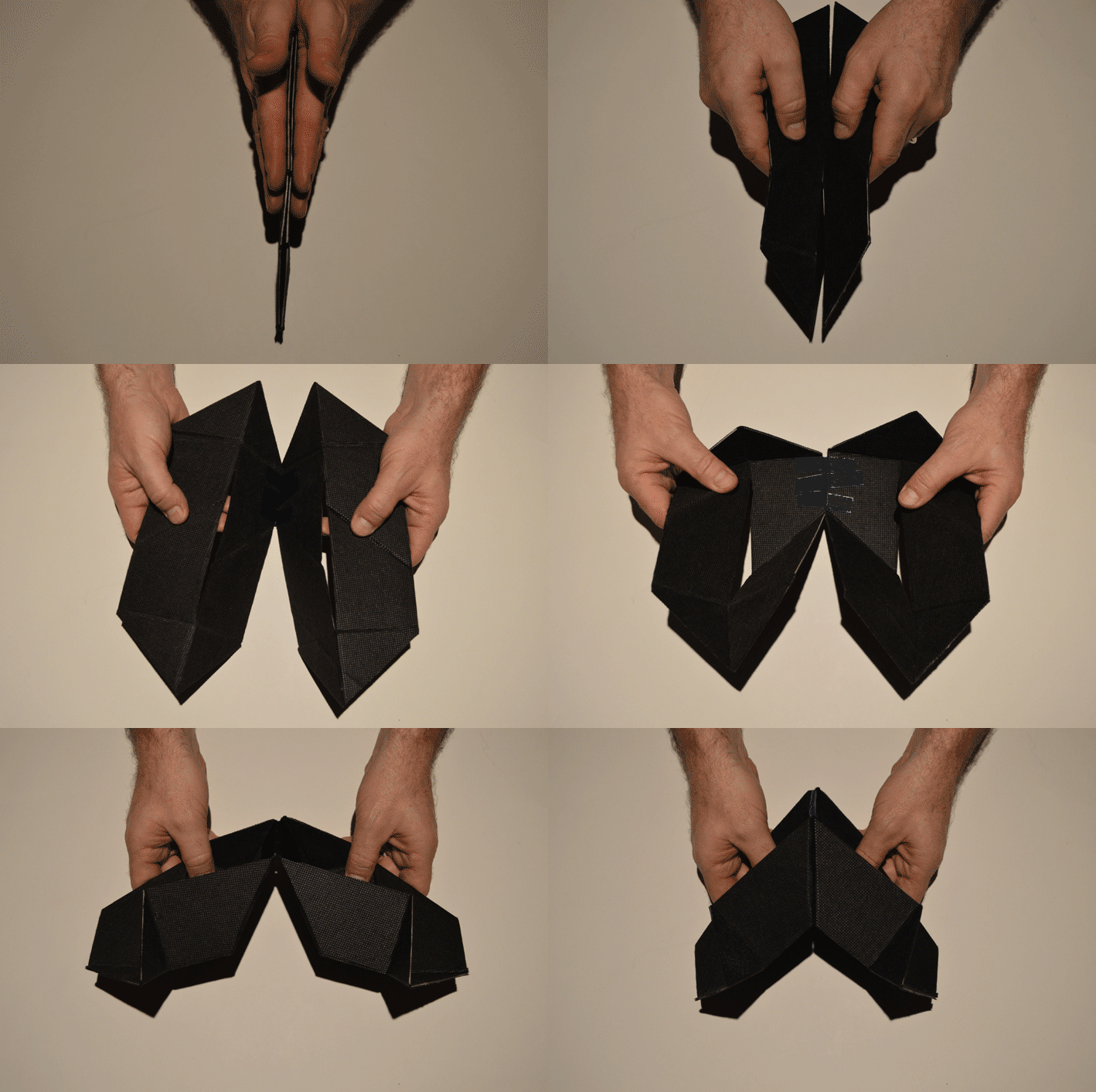
getting my head around the final final structure is a tricky one – working with backwards and upside down with two sides having asymmetrical shapes with reflective material juxtaposed with light absorbing black.
Tuesday, 16 December 2014
openingadoortowhatIdon’tknow
It was great to hear and in some instances see what the other
teams have been up to. The final meeting of Parallel Practices made me even
sadder that I was unable to get to the other meetings as I feel that I have
missed out on the sharing element of the process to some extent.
Anyway – it was in another great new space in London that I
had no idea existed – the Life Science Museum within the Hodgkin Building. To
get to it we walked through a labyrinth of endless shelves with thousands of bottles
of unfamiliar body parts , then past the oddest folk art I have EVER seen (see
above) into a room where we sat a large table surrounded by glorious examples
of skeletal structures. I and Naomi were first up and we talked about new
tools, thinking space, open-endedness, mapping the process, creating taxonomy, although
Richard named the activity. http://www.naomimcintosh.com/
Celia was great and the idea of carving out space for
reflection and thus her revelation that at the core of her work was the idea of
care was beautiful. She spoke very movingly about respect and responsibility
around the bodies she had worked around. http://celiapym.com/
Karina was very focused like her project and she spoke
eloquently about the role of the machine with and verses the hand, the value of
what she was doing as a maker and how stitch and textiles or at least
non-robotic materials could become a part of robotics ‘teaching’. I love the
precision of how she uses language, supporting the finding of the right word
after my questioning of Celia’s comment about the ‘ordinariness’ of her
practice, rather than its extraordinariness in the world of the throwaway. http://www.karinathompson.co.uk/
Tamsin had her workbench nearby and was able to show us all
sorts of wonderfulness; exploding ceramics infested with calcium, crystal
growth on ‘bones’ and a see-though blue mouse. Listening to her and Richard
talk about providing access to the space was empowering. http://www.vanessendesign.com/
There were so many areas where we overlapped – although it
was more of a constellation of possibilities - I could have listened all day.
Some notes I made which I have to think about – it opened a door to what I
don’t know, technology adding a new dimension, anatomy as an act, the
supervised machine, sometimes I can sometimes I can’t, the idea - no the
feeling of ownership, enabling others to rethink what it is that they do, I’m never
going to know what I mean, negotiating a re framing of practice.
Friday, 12 December 2014
somelightthoughts
some thoughts as we move to the final meeting on tuesday.....
This opportunity has diverted me from the thinking patterns I usually engage in and enabled my practice to be opened up, exposed and in turn challenged. I have been presented with new ways of working, practical concerns around problem solving, the creation of rules to work within and different methods of making.
Exposure to these issues has thrown up a number of thoughts - on the one hand exposure to new ways has informed what I do, much of this has been appropriated into my practice over the projects timespan and highlights new possibilities, for example working within a constructed paradigm to generate deep thinking, changing materials but retaining existing structure and actively testing to create data with which to improve existing work or develop new work.
The project has also made visible and so possible what I do but I am now able to re contextualise it - already a part of my practice through the work with OCA the use of Skype has cut down my travel but I now see it as a tool to connect, with the opportunity to work globally or at least with somebody at the end of a computer.
Although collaboration is a large part of my practice - the book form is a collaborative experience - from the many parts or elements that go to make up a book to the people who create it through the numerous specialist processes they engage in. Collaboration within ones own practice is one thing and relatively easy, a shared understanding of the form exists, across art forms another but this is still within a shared understanding of values. Within science thinking it is different. But the project has had at its core respect, respect for the values of others and this has enabled me to release the creative process, relinquishing control and establishing new frameworks.
Searching out ways to fail gloriously
It is important to recognise that my intention was to work in ways I had not previously experienced and to make things that I did not understand. The overarching idea was to attempt to be surprised. This idea of surprising oneself was important - the collaborative work pattern was such that a conversation became an idea which was then developed into a practical working research strand which would become a physical models, structures. If that idea, when becoming manifest, was recognised or understood it was often abandoned and new strands of the unknown were taken up even if the original projected outcomes were to be successful. This led to brand new work which will require long term thinking to consider how it will transform both my ways of working and the work itself. Although there was an interesting discussion around finding oneself becoming the other person, making similar work, although not ones own!
The experiences experienced and lessons learnt will inform my own making when I return to the studio but it will also support and facilitate the teaching I undertake, both formally in three institutions I teach in; Camberwell College of the Arts, Norwich University of the Arts and the Open College of the Arts and informally within the workshops, consultation sessions and residencies I become involved in.
It will also make me an advocate for science and science thinking. For too long Science and Art have been seen as separate and different while during this project I have witnessed a group of people within Thrish's lab creatively problem solving, working deep, thinking laterally and exploring materials - sounds a lot like the creative sector. They also feel comfortable sharing - there is the realisation that one person cannot know it all and that more is possible if knowledge is shared. Although their working patterns of thinking something into existence and then proving it by experiment/experience is similar in some ways to the design world - having in ones mind an answer or vision and working towards it. Rather than working with an idea and setting out not to know and when a direction is decided upon looking out for new routes to get there.
This opportunity has diverted me from the thinking patterns I usually engage in and enabled my practice to be opened up, exposed and in turn challenged. I have been presented with new ways of working, practical concerns around problem solving, the creation of rules to work within and different methods of making.
Exposure to these issues has thrown up a number of thoughts - on the one hand exposure to new ways has informed what I do, much of this has been appropriated into my practice over the projects timespan and highlights new possibilities, for example working within a constructed paradigm to generate deep thinking, changing materials but retaining existing structure and actively testing to create data with which to improve existing work or develop new work.
The project has also made visible and so possible what I do but I am now able to re contextualise it - already a part of my practice through the work with OCA the use of Skype has cut down my travel but I now see it as a tool to connect, with the opportunity to work globally or at least with somebody at the end of a computer.
Although collaboration is a large part of my practice - the book form is a collaborative experience - from the many parts or elements that go to make up a book to the people who create it through the numerous specialist processes they engage in. Collaboration within ones own practice is one thing and relatively easy, a shared understanding of the form exists, across art forms another but this is still within a shared understanding of values. Within science thinking it is different. But the project has had at its core respect, respect for the values of others and this has enabled me to release the creative process, relinquishing control and establishing new frameworks.
Searching out ways to fail gloriously
It is important to recognise that my intention was to work in ways I had not previously experienced and to make things that I did not understand. The overarching idea was to attempt to be surprised. This idea of surprising oneself was important - the collaborative work pattern was such that a conversation became an idea which was then developed into a practical working research strand which would become a physical models, structures. If that idea, when becoming manifest, was recognised or understood it was often abandoned and new strands of the unknown were taken up even if the original projected outcomes were to be successful. This led to brand new work which will require long term thinking to consider how it will transform both my ways of working and the work itself. Although there was an interesting discussion around finding oneself becoming the other person, making similar work, although not ones own!
The experiences experienced and lessons learnt will inform my own making when I return to the studio but it will also support and facilitate the teaching I undertake, both formally in three institutions I teach in; Camberwell College of the Arts, Norwich University of the Arts and the Open College of the Arts and informally within the workshops, consultation sessions and residencies I become involved in.
It will also make me an advocate for science and science thinking. For too long Science and Art have been seen as separate and different while during this project I have witnessed a group of people within Thrish's lab creatively problem solving, working deep, thinking laterally and exploring materials - sounds a lot like the creative sector. They also feel comfortable sharing - there is the realisation that one person cannot know it all and that more is possible if knowledge is shared. Although their working patterns of thinking something into existence and then proving it by experiment/experience is similar in some ways to the design world - having in ones mind an answer or vision and working towards it. Rather than working with an idea and setting out not to know and when a direction is decided upon looking out for new routes to get there.
Tuesday, 9 December 2014
workinginnegativespace
Thinking about the
space the structures work in – this screen shot of a video plus code by Nantachai plots movement and
so enables us to see – I’m doing my own version later – attaching lights to
specific points and through long exposure shooting all will be revealed!
Friday, 28 November 2014
cutcreasedfoldedandgathered
A day of
stacking - looking at how the individual elements when cut, creased, folded and
gathered together behave. The friction created is a form of jamming – the
internal spaces created are intriguing and the pieces start to connect to some
ideas related to ‘bookness’ - especially when viewed from the side - page, leaves, book.
Wednesday, 26 November 2014
alisttoundertake
Reflecting on the second day in London as part of the
parallel practice project – we now have a list of activities to undertake as
final statements – they include using the single ‘spinning’ element and using
it to explore the making of structured sheets, the stack and the
collapsibility, mapping the whole project (possibly through email without
discussing it), making a number of films using the data Nantachai created with
his wonderful coding and adding lights to the work and filming the movement. –
all in the five days remaining. Some of the conversation focused on materials –
what makes a finished piece? What materials say finished? What materials should
the pieces be made with? I’m going to make a visit to the materials library to
check out what’s possible – also it will be a good research trip in
relationship to the teaching I’m involved in at Norwich University of the Arts.
Saturday, 15 November 2014
activelyrecognisingcontrollingpassivity.
ok I think that i might of finally got this soft robotics
thing – reacting to its context, structural memory in deformable objects – yesterday I brought in
a structure to the meeting that I had already shown – but changing the
parameters (making two elements longer) meant that I was able to manipulate it
in one plane – in x and y axis – making it perform in an exaggerated ‘flipping’ motion within a
number of ‘other’ axis’s – this was an easy movement that I performed without
thinking – I had not taken into account – body memory, variable stiffness or
morphological computation - the model was then strapped to a xy table and initially
a circle was coded into the movement of the arm – the uneven forces within the
structure broke the arm which was attached to the structure – the structures construction
meant that when the structure was manipulated it was revealed that the forces
within it were distributed unevenly – something that was felt but overlooked and
not fully understood when manipulated in the hand - then the movement of the
arm was simplified into 4 points in space - a square, even though we had now
worked out that the movement was octagonal – the 8 fitting onto the 4 sides
each and with corners being taken up by an angle– due to the forces a second
arm was broken – (robot war!!! my robots 2 theirs 0) – but with the addition of
a spring the forces were subsumed and the structure moved beautifully – a case
of passive actuation in practice.
The body makes and compensates for millions of movements
continuously without recognising them – a robot which engages with its context
has to undergo a similar process but it has to know – the maths involved in the
coding is so mind boggling – I get it......actively controlling the passivity.
Friday, 14 November 2014
artandsciencetakingplacesimultaneously
Our 3rd meeting – what a day as ever so many
thoughts and ideas but somehow today everything gelled – some ideas are becoming
concluded (for now) – others expanded (later)- the video of swirling data
surrounding and swirling around and within one of our structures mapping light
levels oooooooooooohhhh – it just looked like SCIENCE- this led to us thinking
about mapping and documentation – so we are planning to document all the structures we have made – reflecting on
them and mapping the connections by remembering and creating links between them
– thinking around the idea of genetics – the children of the parent structures –
this will be undertaken in a number of ways - visually, with the knowledge of
what led to what within a linear timeframe and also by applying code to map
similarities. Some filming took place – we pretended to look and talk
spontaneously – painful but it meant that myself and Naomi got time to discuss
and plan for the next sessions (running a workshop for PHD students). Also the
lab did look really cool – art and science taking place simultaneously both
feeding off each other so that it was difficult to work out when one concluded
and the other started.
Wednesday, 12 November 2014
translationandrotationvariablestiffnessandmultipleforces
The complicated dynamics of creating collaborative work with
4 people from 3 different disciplines, working together over 500 miles apart
who then purposely set out to gain enlightenment through not knowing has so far
yielded a wealth of ideas and models. It has already promoted radically new
ways of thinking and working that will inform our practices for years to come.
At
the initial opening up stage we created over 200 models. We are now focusing
our energies on developing a number of specific forms that explore particular
ideas; translation and rotation, variable stiffness and multiple forces. The
openness to possibilities has created a huge conceptual creative space which we
are enjoying, contemplating the next stage, which also includes a return to our
previous lives will involve evolving some conclusions which will bring us to exploring
and then using materials new to us.
Friday, 7 November 2014
joiningaproductionline
a day of refining and joining - the inevitable production line and eventually satisfaction. The work today was about trying to both explore ideas of multiple and joining whilst creating a more 'finished' piece that can be mapped and monitored next week at our meeting at Kings.
Subscribe to:
Posts (Atom)